


How To Go Green With Oceans Republic Bamboo Panel Products
- Oceans Republic
- Dec 15, 2022
- 10 min read

Updated: Jun 24
Going green is all the rage nowadays and for good reason! There are so many ways to make your home and lifestyle more eco-friendly, and one of the best ways to do that is by using bamboo panel products. Bamboo panels are a great way to reduce your environmental impact while also enjoying beautiful, high-quality products. Oceans Republic offers a wide range of bamboo panel products, all made from sustainably harvested bamboo. Choose from cutting boards, countertops, drawer organizers, and more!
Keep reading to learn more about how you can go green with bamboo panel products from Oceans Republic!

How Bamboo Panels Are Made
Bamboo panels are a popular building material due to their sustainable and renewable qualities. They're made using bamboo stalks which are cut into thin strips, then glued together in layers. The bamboo strips are then pressed to create a solid panel. To ensure durability, the sheets are then laminated with resins or phenolic adhesives which help seal the panel and provide an extra layer of protection from moisture. Once the bamboo has been treated and pressed together, it can be used as flooring, wall panels, furniture, cabinetry, and more.
Bamboo is generally very strong and durable making it perfect for many different applications. It has also become increasingly popular recently due to its aesthetic appeal as well as how much cheaper than traditional materials it is. With the right care and upkeep, bamboo panels can last decades with minimal maintenance required. This makes them a great option for those looking for a cost-effective and eco-friendly material..
Horizontal and Vertical Bamboo Panels
When making a decision on which type of bamboo panel to use in a project, horizontal and vertical panels are the two main options. Both horizontal and vertical bamboo panels offer unique benefits that can be used for a range of applications.

Horizontal bamboo panels are made from natural, sustainable materials like bamboo that offer a unique and elegant look to any space. Horizontal bamboo panels feature strips that run parallel to each other, creating an aesthetically pleasing look with horizontal lines. These bamboo panels are best suited for wall coverings, cabinet doors, furniture, and other applications.

Vertical bamboo panels on the other hand feature strips that run vertically, creating a more contemporary look with vertical lines. Vertical bamboo panels are well-suited for ceilings, walls, and surfaces where height is preferred over width.
When choosing between horizontal and vertical bamboo panels, it is important to consider how they will be used in the space. Whether horizontal or vertical lines are desired, both horizontal and vertical bamboo panels can add an attractive touch to any project. With careful consideration of their unique benefits and application requirements, horizontal and vertical bamboo panels can help create beautiful spaces inside or outside the home or your favorite kitchenware and tableware.
No matter which type of bamboo panel you choose, both horizontal and vertical panels will provide a stylish and luxurious look to your products.

If you specify, import or resell panel materials, "bamboo" can mean a dozen different products — and the differences decide whether a project succeeds or gets a freight claim. This guide is written from the factory floor. We make these panels in Vietnam, ship them to buyers in North America, Europe, the Gulf and Australia, and field the same sourcing questions every week. Here is what actually matters when you buy bamboo plywood and bamboo wall panels, and how to spec them so they arrive right the first time.
Oceans Republic manufactures bamboo panels and finished bamboo products from FSC-certified material, with custom, wholesale and white-label supply for retailers, distributors, hospitality groups and private-label brands.
What bamboo plywood actually is — and what it isn't
Bamboo plywood is an engineered panel built from milled bamboo strips that are kiln-dried, laminated edge to edge into a single layer, then cross-laminated and heat-pressed into multi-ply sheets. Cross-graining each layer against the next is what gives the finished panel its dimensional stability — a well-built bamboo panel is several times more stable than solid oak and resists the seasonal movement that splits hardwood.
One distinction trips up a lot of first-time buyers. A growing share of "bamboo wall panels" sold online are not solid bamboo at all — they are an MDF or WPC (wood-plastic composite) core with a thin bamboo-look veneer or a PVC film wrap. They are cheaper, and for some decorative jobs they're fine. But if your brand sells on sustainability, a plastic-and-glue core undercuts the story. Solid bamboo plywood is a different product: it is bamboo through the section, finishable like timber, and it carries the environmental claim honestly. For a company built to replace single-use plastics, that difference is the whole point.
The three grain types: horizontal, vertical and strand-woven
Grain is the first spec decision, because it changes both look and hardness.
Horizontal (flat-grain) bamboo lays the strips wide-side-up, so the bamboo's natural nodes stay visible. It reads as warmer and more organic and suits cabinet faces, furniture and decorative surfaces where buyers want the material to look like bamboo.
Vertical (edge-grain) bamboo turns the strips on edge, producing fine, uniform parallel lines with no visible nodes. It looks more contemporary and consistent, which is why it's the default for many cabinetry and architectural jobs.
Strand-woven bamboo is a different construction entirely: bamboo is shredded into strands, saturated with resin and compressed under enormous pressure. The result is the hardest of the three by a wide margin — strand-woven bamboo typically tests well above red oak on the Janka hardness scale — which makes it the choice for countertops, flooring, stair treads and anywhere the surface takes abuse.
If you're undecided, send us the application and we'll recommend the grain and ply build to match. The original horizontal-versus-vertical question that brought many readers to this page is really a question about where the panel will live and how hard it has to work.
Thicknesses, sizes and panel construction
This is where a spec sheet earns its keep. Bamboo plywood is produced across a wide range:
Thickness: roughly 1.5mm, 3mm, 5mm, 9mm, 12mm, 15mm, 18–19mm, 20mm, 30mm and up to 40mm. Veneers run around 0.6mm.
Standard sheet: 4ft x 8ft (2440 x 1220mm), with longer custom lengths for countertops and stair treads.
Ply build: single-ply, 3-ply, 5-ply, 7-ply or 9-ply. A 20mm panel, for example, is commonly built as a 4–12–4 three-layer lay-up. Balanced, symmetrical construction is what keeps a thick panel flat.
Thicker, higher-ply panels cost more and weigh more but carry more load — the right answer depends on span, fixings and use, not on a single "best" number. Tell us the job and we'll spec the build.
Carbonized vs natural: colour and a hardness trade-off
Colour comes from process, not stain. Natural bamboo keeps its pale amber tone. Carbonized bamboo is steam-heated to caramelise the sugars in the fibre, deepening it to a coffee-brown; a darker "chocolate" grade pushes it further. Worth knowing at the spec stage: carbonising softens the fibre slightly, so a carbonized panel is marginally less hard than its natural equivalent. Both can be sanded, stained and finished like ordinary timber, so you can adjust the final look downstream.
Where bamboo panels are used
The honest answer is: almost anywhere you'd use furniture-grade plywood, plus a few places you wouldn't expect.
In cabinetry, joinery and furniture, bamboo panels behave like a premium hardwood ply with a more consistent grain and a better sustainability story. In kitchens — countertops, worktops, cutting boards, tableware and kitchenware — bamboo's hardness and moisture resistance do real work, which is exactly why food-contact compliance matters and why we run that production through an FDA-registered facility. In retail and hospitality fit-outs, bamboo surfaces give specifiers a material that satisfies both the design brief and the ESG brief at once.
The fastest-growing decorative application is fluted, slatted and acoustic bamboo wall panels for commercial interiors — hotels, restaurants, offices and studios. This is a real opportunity, and it's where the solid-bamboo-versus-composite distinction above becomes a selling point: a genuine bamboo wall panel competes on sustainability against the MDF-and-PVC products that dominate that market. If you're sourcing for an interiors or hospitality programme, talk to us about custom panel manufacturing.
Is bamboo plywood durable, water-resistant and safe?
Durable: yes, and measurably so for strand-woven grades. With basic care, bamboo panels last decades, which is part of their lifecycle value argument against cheaper materials that get replaced.
Water-resistant, not waterproof: bamboo plywood is stable in kitchens and bathrooms, but it is not a marine or unprotected-exterior product unless it's specifically treated and finished for it. For outdoor work, specify a weather-treated grade and seal it properly.
Safe: because the panel is bonded, "safe" means verifying the emission class for your market and use. Don't take a generic "eco-friendly" label at face value — ask for the test report. We supply low-formaldehyde panels with SGS testing and FSC-certified material, and we'll provide the documentation your customs broker and your buyer will ask for.
A note on a claim you'll see everywhere, including in our own older copy: bamboo is often marketed as simply "cheaper" than wood. That's not quite right, and overstating it sets up disappointment. Bamboo plywood is cost-competitive with quality hardwood ply and frequently wins on lifecycle value and sustainability — but a good strand-woven panel is a premium product, priced accordingly. Buy it for what it is.
Bamboo plywood vs hardwood plywood
Against hardwood plywood, bamboo's advantages are renewability (a five-to-seven-year crop versus decades), dimensional stability (typically several times more stable than oak), and a hardness ceiling — in strand-woven form — that exceeds common hardwoods. Hardwood ply still wins on familiarity, the widest range of species looks, and established exterior grades. For most interior cabinetry, furniture and surface applications where sustainability is part of the buying decision, bamboo is the stronger story and the comparable-or-better material.
Why source bamboo panels from Vietnam
For importers, country of manufacture is now a strategy question, not just a price question. Concentrating a panel supply chain in a single country carries risk; building a second source in Vietnam is straightforward supply-chain diversification, and it keeps you next to skilled, scaled bamboo manufacturing rather than starting over.
What Oceans Republic adds on top of the Vietnam base:
An FDA-registered facility and SGS testing — the documentation your buyers and brokers require.
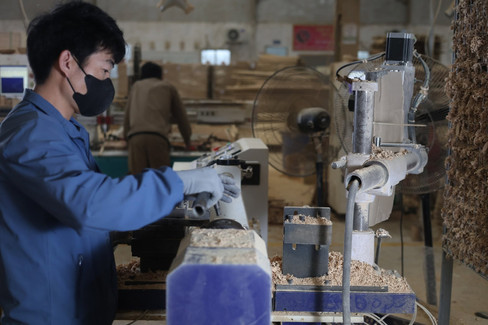
Scalable manufacturing, not one-off handcraft, so your volumes and quality stay consistent order to order. See the factory.
Full OEM, white-label and wholesale programmes, with custom thickness, grain, size and finish to your spec.
This is also why a growing number of North American businesses source through us.




A short sourcing checklist before you place an order
Whoever you buy from, confirm these six things in writing:
Emission class for your market (CARB / TSCA Title VI, or E1/E0) — with a test report, not a claim.
Grain and construction (horizontal / vertical / strand-woven; ply count and lay-up) matched to the application.
Moisture spec and finish if any part of the job is exposed to water or weather.
Certification — FSC chain of custody, and food-contact / FDA status if relevant.
MOQ, lead time and Incoterms (FOB, CIF or DDP) so landed cost and timing are clear up front.
Sampling — get a physical sample of the exact grade before committing a container.
We'll answer all six on a single quotation.
Frequently asked questions
What thicknesses and sheet sizes does bamboo plywood come in? From roughly 1.5mm to 40mm, with the standard sheet at 4ft x 8ft (2440 x 1220mm) and longer custom lengths available. Veneers run around 0.6mm. We produce custom thicknesses, ply counts and panel sizes to order.
Is bamboo plywood formaldehyde-free and safe for food contact? It's a bonded panel, so emission class is what to verify. We supply low-formaldehyde panels and make food-contact items such as cutting boards in an FDA-registered facility, with SGS testing and FSC-certified bamboo. For US or EU export, confirm CARB Phase 2 / TSCA Title VI or E1/E0 against your market.
What's the difference between horizontal, vertical and strand-woven bamboo? Horizontal shows the natural nodes for an organic look; vertical is linear and uniform with no visible nodes; strand-woven is compressed fibre and the hardest of the three, testing well above red oak on the Janka scale.
Is bamboo plywood waterproof or suitable for outdoor use? It's moisture-resistant and stable indoors, including kitchens and bathrooms, but not for unprotected exterior use unless specifically treated and finished. Specify a weather-treated grade for outdoor projects.
What is the minimum order quantity for wholesale bamboo panels? It depends on product, thickness and finish. We support wholesale, OEM and white-label orders and confirm MOQ, lead time and Incoterms on quotation.
Why source bamboo plywood from Vietnam instead of China? For supply-chain diversification away from single-country dependence, while keeping skilled bamboo manufacturing. We add FSC-certified sourcing, an FDA-registered facility, SGS testing and full OEM / white-label / custom capability.
The Top 8 Reasons to Use Bamboo Panel Products from Oceans Republic
Eco-Friendly: Bamboo panel products from Oceans Republic are designed to reduce your carbon footprint. By using bamboo, a renewable resource that doesn’t require any pesticides or nasty chemicals, you can easily reduce your environmental impact and help preserve the planet we all share.
Durable: Bamboo panel products from Oceans Republic are incredibly sturdy and durable. This means that not only will they last longer than other materials like plastic, but their water-resistant properties also make them perfect for use in kitchens and bathrooms where moisture is more likely to be an issue. Beautiful Design: With its natural look and feel, bamboo panel products from Oceans Republic bring a unique, beautiful design to any space. Whether you’re looking for kitchenware or decorative elements, bamboo panel products from Oceans Republic have you covered. Versatile: Bamboo panel products from Oceans Republic are incredibly versatile – they can be used as countertops, kitchenware, tableware, office furniture and more! This makes them perfect for anyone looking to add an element of beauty and sustainability to their home or office. Cost-Effective: Eco-friendly doesn't have to mean expensive; bamboo panel products from Oceans Republic are actually quite cost-effective. Not only will you save money on materials over the long run but you'll also be able to enjoy your purchase knowing that it was made with sustainable practices. When you're looking for bamboo kitchenware, furniture, or other decorative pieces for your business, make sure to order with Oceans Republic for quality bamboo panel products. With the top five reasons listed above, it's no wonder why so many people are choosing bamboo panel products from Oceans Republic! Easy to Clean: Bamboo panel products from Oceans Republic are incredibly easy to clean and maintain. All you need is warm water and a damp cloth! This makes them perfect for use in areas like kitchens where there may be a lot of food debris that needs cleaning up. Hypoallergenic: Because bamboo is naturally hypoallergenic, it's perfect for people who suffer from allergies or asthma. Bamboo panel products from Oceans Republic won't cause any allergy flare-ups and can provide peace of mind to anyone with sensitivities. Lightweight: Bamboo panel products from Oceans Republic are incredibly lightweight, which makes them perfect for areas where weight is a concern. They won't weigh down walls or cabinets and can be easily moved around without having to worry about any damage being done.


For the highest quality bamboo panel products that are sustainable, beautiful, and cost-effective, choose Oceans Republic! With these top eight reasons listed above, it's no wonder why so many people trust Oceans Republic for their bamboo panel product needs. Make your business stand out by ordering our bamboo panel products today! Browse our selection of bamboo panel products and find the perfect products to match your needs.
Get a quote or request samples
If you're specifying bamboo panels for a product line, a fit-out or a private-label range, send us the application and target volumes and we'll come back with a grade recommendation, MOQ, lead time and landed-cost options.


Comments